

Stories & Insights
Why Art Is the New Competitive Advantage in Commercial Real Estate

Image: Tous les bleus by Damiano Austin hangs near a sleek elevator in a bright lobby at Radnor Court.
For decades, commercial real estate was evaluated on location, square footage, and hard costs. Today, tenants and investors weigh something harder to spec: how a place makes people feel, and what it gives back to the community around it.
Forward-looking owners, developers, and asset managers are answering that shift with art, which delivers business value and measurable social impact at once. That's shared value, and it starts the moment a place is first imagined.
Highlights
- Art delivers business value and measurable social impact. Through ArtLifting, artists with disabilities earn 55% of profits, giving owners and asset managers a concrete, reportable social outcome.
- Art creates the greatest shared value when it's part of a property's plan from the initial concept, not a finishing touch, strengthening leasing, property identity, and tenant experience across a building's full lifecycle.
- ArtLifting delivers turnkey, scalable art programs with flexible rentals and rotating collections that keep environments active, with no added art-inventory burden for owners or asset managers.
Buildings now compete on experience
The success of commercial real estate projects is often measured by occupancy, leasing velocity, and long-term asset performance. Today, another factor shapes a property's success just as powerfully: the experience it creates.
The market is already rewarding it. In the second quarter of 2026, prime office space was 12.3% vacant, compared with 18.3% across the market overall, according to CBRE data. Tenants are choosing buildings that offer more, and the experience a building creates is part of that. Art is one way owners shape it.
Art has become a competitive advantage in commercial real estate because it provides a unique experience where owners and operators can differentiate their space and compete.
Most investments in experience only pay back once: a better first impression, a stronger sense of place. Art, integrated early, pays back twice. It does that same work, and because the artwork itself creates economic opportunity for the artist behind it, it carries a second return that most line items in a building's budget don't: a measurable social impact.
Art offers the greatest shared value when integrated from the initial concept and not treated as a finishing touch. The projects that create lasting value aren't simply well designed. They create places people remember and want to inhabit.
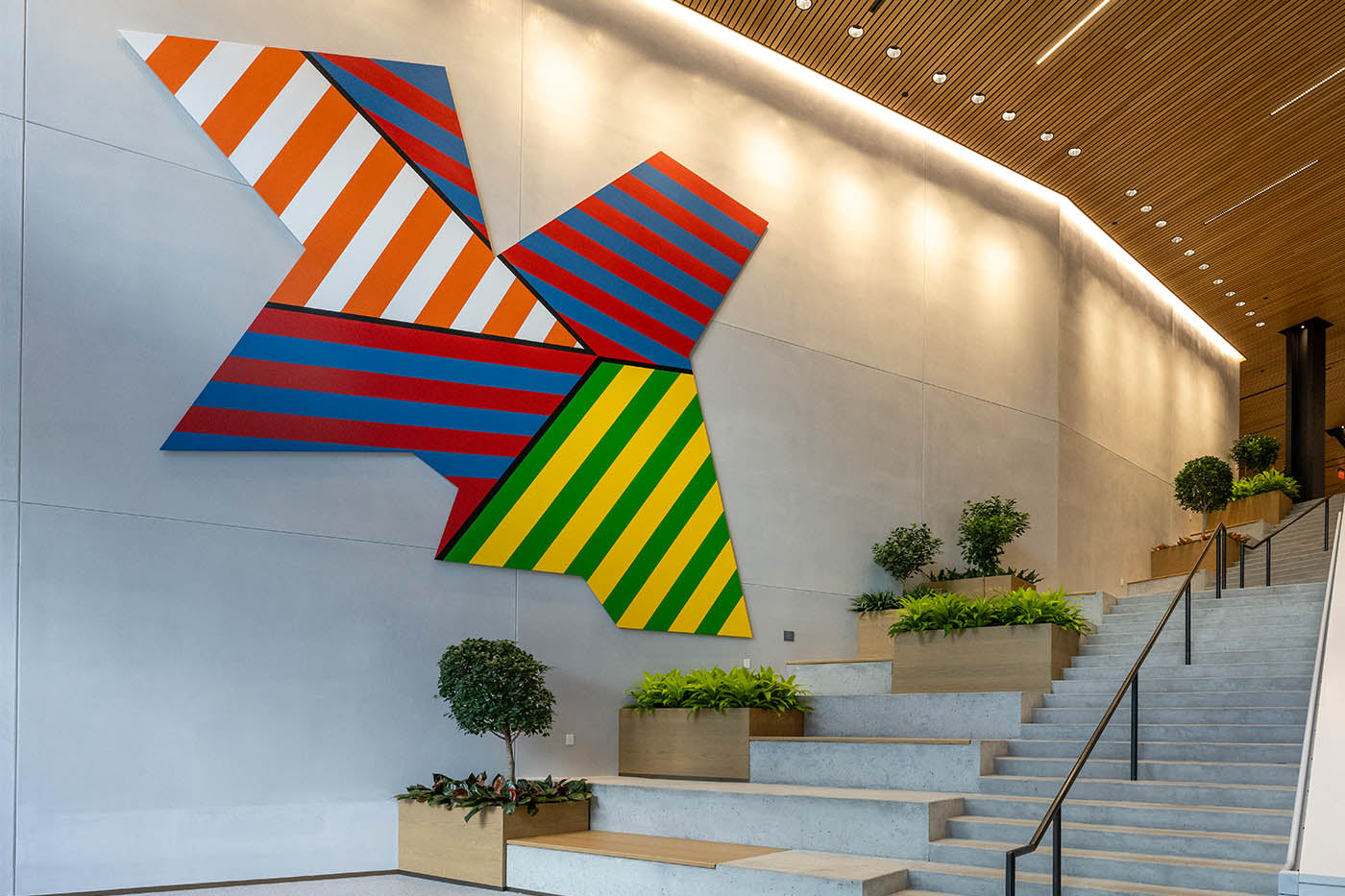
Image: Rudolph Jean Louis’s 20’x20’ commissioned piece, Doctrine of Obscurity, installed in the main lobby of 400 Summer St. © Vaderwarker Photography.
Art is infrastructure for human connection
Floor plans, furnishings, and amenities define how a new development is utilized. But people increasingly choose where to work, gather, shop, and spend time based on how a place makes them feel, not just on its functional elements.
That preference shows up in consumer spending. In JLL's 2025 global consumer survey of 12,000 people across 64 cities, 69% said they would pay a premium for a high-quality experience, up from 65% a year earlier.
Great places create identity, a sense of destination, and lasting impressions that generate word-of-mouth and keep people coming back. These outcomes result from intentional decisions, from architecture to programming, hospitality, and art, all working in concert to shape how a place looks and feels.
Shared value in commercial real estate doesn't come from the artwork alone. It comes from the human connection the artwork creates.
Just as architecture shapes how people move through a space, art shapes how they connect to it.
Art creates moments of reflection, sparks conversation, reinforces identity, and becomes part of the social infrastructure that supports belonging, engagement, and community. Sourced with intent, that infrastructure builds community inside a property and beyond it.
The effect of art on experience is measurable. In a 2022 study of placemaking across office, retail, transit, and residential settings, spaces shaped by intentional placemaking and art made people 50% more likely to want to spend time there and produced a 53% increase in self-congruity, the degree to which people saw themselves in, and identified with, a place. That sense of recognition, and the desire to linger, is exactly what turns a building into a place where people feel they belong.
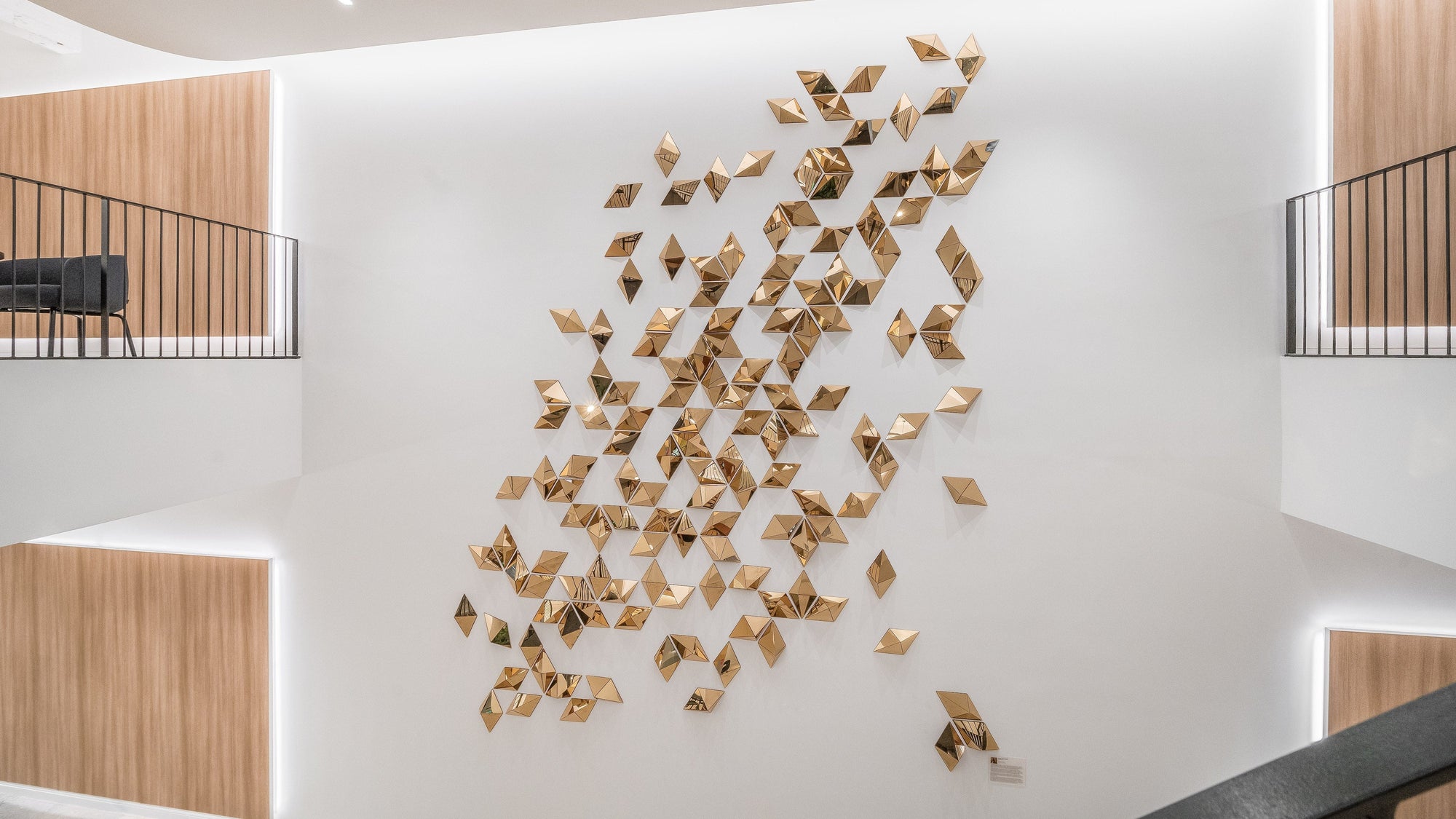
Image: Eliza Redmann’s sculptural wall installation, Diamond Dream, graces the lobby of JRM with its striking presence.
Art helps a building do its job at every stage
Most amenities decorate, market, or maintain a building without doing the work the property needs done. Art, integrated across the lifecycle, does that work. ArtLifting manages art like asset managers manage a portfolio, stewarding art’s impact at every stage of the building's life.
- During development and construction, art activations turn a disruptive site into a platform for community goodwill. Solutions like custom scrims, murals, and commissioned public artworks are particularly relevant.
- Throughout leasing, art becomes a property differentiator: reinforcing identity and giving leasing teams a memorable story to sell beyond square footage.
- Once tenants arrive, art creates the everyday moments of connection that turn a space people pass through into a place people return to.
ArtLifting art programs, such as rentals and rotating collections, keep spaces fresh without renovation, and minimize the cost of asset management and insurance.
ArtLifting artwork activates over 100 million square feet of space globally. For the full stage-by-stage vision of how art can enhance business outcomes for new developments, read our companion piece, Art Across the Building Lifecycle: 4 Stages From Construction to Occupancy.


Image 1: Large-scale architectural scrims featuring artwork by Junco Norton.
Image 2: Cityscape Reflection by Chris Van Loan Sr., an abstract city skyline mirrored in calm blue water with bold yellow, green, and red accents, displayed at Radnor Court.
Image 3: A modern lounge at BGO's 777 6th St. NW features print reproductions of Karade’s Sankofa I and Karade’s Sankofa II by ArtLifting artist Diyah Najah
Art creates business value and social value at once
A thoughtfully integrated art program delivers on the business side, exactly as any strong placemaking investment should. The second return is where ArtLifting art stands apart: it creates social value directly, supporting local artists, generating economic opportunity, strengthening community, amplifying diverse voices, and fostering belonging.
ArtLifting's model makes that social return concrete.
Artists earn 55% of profits of art sales, more than standard gallery representation or traditional art consultancy models. A further 1% of profits supports ArtLifting's Community Impact Fund, which supplies art materials to individual artists and to nonprofits serving communities impacted by disability.
To date, ArtLifting has sold tens of millions of dollars of artwork in partnership with talented disabled artists. For a community that has long faced barriers to employment and income, every installation is proof of the opportunity and social impact art in commercial real estate creates.
Social impact becomes something owners can report
More owners, investors, and tenants recognize social impact as a priority, and percent-for-art programs in many communities typically set aside about 1% of project budgets for art, with some going as high as 2%. A socially aligned art program can influence prospective tenants weighing where to locate, support partners evaluating a fund, and make a property's commitment to community impact and inclusion visible.
Owners and asset managers want bespoke curation at every property, not one look stamped across a portfolio. Working with a single trusted art provider with a large artist network supports site-specific curation at scale without the complexity.
Here's where art becomes uniquely powerful. Placemaking investments deliver experience. ArtLifting's model delivers both experience and a measurable social outcome: dollars paid directly to artists with disabilities and income opportunities for artists who remain underrepresented in the art market. It's a result owners can report, not just a commitment.
Social impact can be one of the harder parts to quantify in sustainability or ESG (Environmental, Social, and Governance) reporting. An art program that pays artists directly gives owners a concrete figure they can point to.
A lobby installation becomes a metric in an impact report or a contributor to building certifications. A leasing differentiator becomes a demonstrable social impact. With ArtLifting, social impact is guaranteed and measurable.
The artist's story is what people remember
Architecture and design shape how people move through and use a space, but stories shape how people remember it. What makes ArtLifting’s approach distinct is the story behind every piece, sometimes as much as the artwork itself. Every artwork represents the perspective, talent, and lived experience of an artist with a disability.
Paired with the artist's story, artwork becomes an invitation for curiosity, empathy, and conversation.
For the artist, that story creates visibility, recognition, and income. For tenants and visitors, ArtLifting artwork creates a moment of human connection that lasts far beyond the physical environment.
Owners and developers feel that difference too. Across ArtLifting's commercial real estate partnerships, the response is consistent: the artist's story is what turns a building's art program from decoration into something people remember.
Art belongs in the plan from the first concept
The greatest opportunity for art doesn't begin when construction ends. It begins when a vision for a place is first imagined. When art is treated as infrastructure, art becomes part of how a place creates identity, fosters connection, and delivers value over time, for the business and the local community.
Commercial real estate has always been about optimizing value and performance. Increasingly, the experiences people have within a place, and the good a place puts back into the world, support that value.
The projects that create the greatest long-term value aren't simply occupied. They're remembered.
ArtLifting combines strategic curation, artwork by professional artists with disabilities, authentic artist storytelling, and flexible art programs that evolve with a property's goals, helping organizations create places people remember and generate measurable social value while they do it.
Connect with an ArtLifting Art Advisor to bring art into your vision from the start.
You may be interested in...


